Cash Flow Yield - The Business Price Tag
Welcome back to The Barakah Investor - a weekly newsletter on patient, halal investing taught the right way.
Last week, we discussed the predictive power, or lack thereof, of market cycles, specifically what they projected for 2026 based on 98 years of data. If you missed it, the takeaway was simple: cycles offer historical context, not a crystal ball. They tell you what happened, not what will. This week, we move from the macro to the micro, focusing on a metric that provides a far more grounded assessment of value, one that cuts through the noise of market sentiment.The Price Tag of a Business: Free Cash Flow Yield
You want to know what a business is worth. The market gives you a price. Your job is to determine if that price is a good deal. Many metrics exist, but few offer the directness and honesty of Free Cash Flow (FCF) Yield. It's the simplest way to see the cash you get for the price you pay, assuming the business keeps operating as is.What It Is and Why It Matters
Free Cash Flow is the cash a company generates after accounting for cash operating expenses and capital expenditures. It's the money left over that can be used to pay down debt, issue dividends, buy back shares, or reinvest in growth without needing external financing. It's the lifeblood of a healthy business. FCF Yield is simply Free Cash Flow per Share divided by the current Share Price. Or, more practically, it's the company's total Free Cash Flow divided by its Enterprise Value (Market Cap + Net Debt). I prefer the latter as it accounts for the entire capital structure. A high FCF Yield suggests you are getting a lot of cash flow for your investment. A low yield suggests the opposite. Why does it matter? Because cash is real. Earnings can be manipulated through accounting choices. Book value can be subjective. But cash flow, particularly free cash flow, is harder to obscure. It represents the actual economic benefit the business provides to its owners. If a business isn't generating free cash, it's not a business you want to own for long, regardless of what its income statement says.Why this matters more for halal investors
For halal investors, FCF Yield takes on additional significance beyond just a measure of financial health. Our primary concern is often the underlying business's real economic activity and its ability to generate wealth ethically. Businesses reliant on excessive debt or speculative financial engineering often show distorted or volatile earnings, making them difficult to assess through traditional P/E ratios. FCF, by its very nature, filters out much of this noise. It focuses on the operational cash generation, the actual production of goods or services, and the efficient management of capital. This aligns directly with the halal principle of investing in productive, tangible assets and avoiding excessive financial trickery. A strong, consistent FCF yield indicates a healthy, self-sustaining business less reliant on debt for survival or growth, which is a core tenet of halal investing. Moreover, FCF is the source of distributable profits, which is what we ultimately seek as owners.Practical Framework for Using FCF Yield
Here’s how I integrate FCF Yield into my analysis:Calculate FCF Yield consistently.
Always use TTM (Trailing Twelve Months) Free Cash Flow and Enterprise Value. For Enterprise Value, use Market Cap + Total Debt - Cash & Equivalents. This gives you a clear picture of what you're paying for the entire business, not just the equity. Ensure the FCF calculation is consistent across companies; I typically use Cash Flow from Operations minus Capital Expenditures.Compare FCF Yield to the risk-free rate.
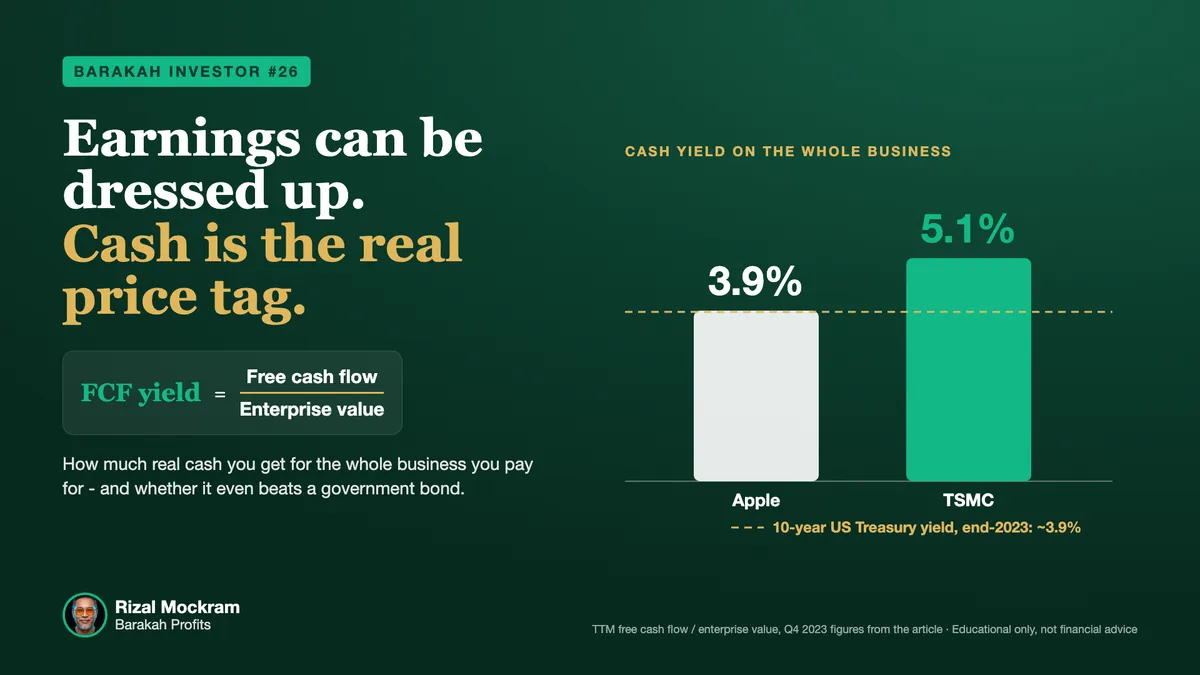
A baseline FCF Yield should ideally exceed the prevailing risk-free rate (e.g., 10-year US Treasury yield). If a business generates less cash flow than a government bond, it needs a compelling growth story to justify the added equity risk. If the FCF Yield is barely above the risk-free rate, the market is pricing in significant future growth or simply overvaluing the present.Compare FCF Yield to historical averages and peers.
Context is key. A 5% FCF Yield might be excellent for a stable utility but poor for a high-growth tech company. Look at the company's own historical FCF Yield range. Has it consistently traded at a certain yield? Also, compare it to direct competitors. Are you getting more cash flow for your dollar with Company A than with Company B, assuming similar business quality and growth prospects?Understand the drivers of FCF.
A high FCF Yield is good, but you need to understand why. Is it sustainable? Is it due to a temporary boost in sales, deferred capital expenditures, or efficient operations? Conversely, a low FCF Yield might be justified by significant, high-return investments for future growth. Always look beyond the number to the underlying business dynamics.
Worked Example: Apple (AAPL) vs. Taiwan Semiconductor Manufacturing (TSM)
Let's look at two companies you're likely familiar with:Apple (AAPL) - as of Q4 2023 (TTM)
- Market Cap: $2.8 trillion
- Total Debt: $104 billion
- Cash & Equivalents: $62 billion
- Enterprise Value: $2.8 trillion + $104 billion - $62 billion = $2.842 trillion
- Free Cash Flow (TTM): $111 billion
- FCF Yield: $111 billion / $2.842 trillion = 0.039 or 3.9%
Taiwan Semiconductor Manufacturing (TSM) - as of Q4 2023 (TTM)
- Market Cap: $600 billion
- Total Debt: $40 billion
- Cash & Equivalents: $50 billion
- Enterprise Value: $600 billion + $40 billion - $50 billion = $590 billion
- Free Cash Flow (TTM): $30 billion
- FCF Yield: $30 billion / $590 billion = 0.051 or 5.1%
This week's action
- Identify 3-5 companies you are currently researching or own.
- Calculate their TTM Free Cash Flow and Enterprise Value using their latest financial reports.
- Determine their current FCF Yield.
- Compare these yields to the current 10-year US Treasury yield and their historical FCF Yields over the past 5 years.
Rizal M
Founder, Barakah Profits
The Barakah Investor is educational only and not financial advice. Always do your own research and consult a qualified professional where needed.
PS - halal verdicts change, and almost nobody shows you when. We keep a dated, public record of every stock that has crossed our halal screen: the verdict ledger.