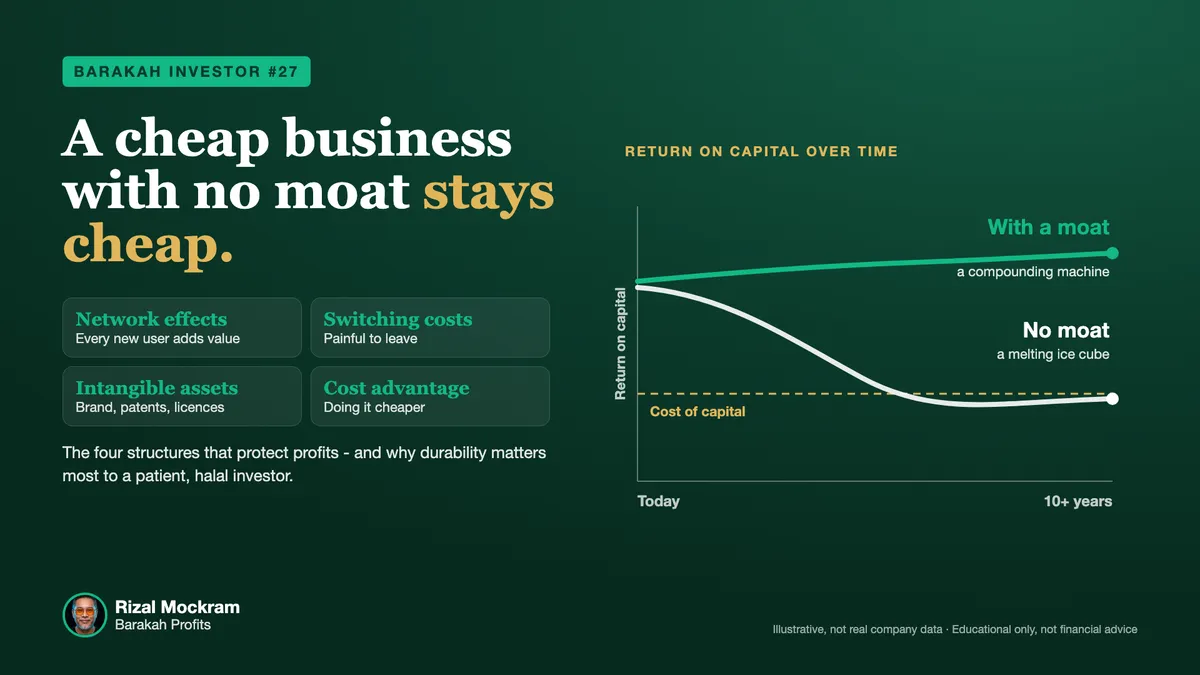
Competitive Moats - Protecting Your Capital
Welcome back to The Barakah Investor - a weekly newsletter on patient, halal investing taught the right way.
Last week, we discussed Cash Flow Yield as the business price tag. A high yield suggests a cheap business. But a cheap business with no durable competitive advantage often stays cheap, or worse, gets cheaper. Price matters, yes, but only when paired with quality. And quality, at its core, is about durability.
The Illusion of Durability
A moat is often discussed, rarely defined with precision. It is not just high margins or market share. Those are symptoms, not causes. A true moat is a structural advantage that protects a business's profits from competitive forces. It allows a business to earn returns on capital above its cost of capital for an extended period. Without it, profits are fleeting, easily eroded by new entrants or existing rivals. Identifying a durable moat is the difference between investing in a compounding machine and a melting ice cube.
Why this matters more for halal investors
Halal investing emphasizes long-term ownership of ethical, sustainable businesses. Speculation on temporary fads or businesses with weak competitive positions contradicts this ethos. We are not interested in quick flips based on transient hype. We seek businesses that can generate consistent, growing free cash flow over decades, allowing us to participate in their genuine economic progress. This long-term horizon makes moat assessment even more critical. A temporary edge might last a few years; a true moat can last a generation. Our investment horizon is often longer than conventional portfolios, aligning with patient capital. This requires a deeper understanding of what truly protects a business.
Practical Framework: Identifying Durable Moats
Network Effects: The More, The Merrier
This moat strengthens as more users join. Think social media platforms, payment networks, or online marketplaces. Each new user adds value to the existing user base, making the service more attractive. Exiting becomes costly. Examples: Visa (V), MasterCard (MA), Meta (META) – though halal screens apply. For Visa, every merchant accepting it makes it more useful for cardholders, and every cardholder makes it more useful for merchants. This creates a powerful, self-reinforcing loop. It's difficult for a new entrant to replicate this scale quickly.
Switching Costs: Painful to Leave
These are the costs, both monetary and non-monetary, that a customer incurs when changing from one product or service to another. Enterprise software, financial services, or industrial equipment often exhibit high switching costs. Consider an ERP system. Migrating all company data, training employees, and integrating new systems is a massive undertaking, far outweigh beyond the software license cost. Companies like Oracle (ORCL) or Microsoft (MSFT) with their enterprise offerings benefit immensely from this. It keeps customers locked in, even if a competitor offers a slightly better or cheaper product.
Intangible Assets: Brand, Patents, Licenses
These are non-physical assets that provide a competitive edge. Strong brands command pricing power and customer loyalty. Patents protect intellectual property, granting exclusivity. Government licenses or regulatory approvals can create high barriers to entry. Think of Coca-Cola's (KO) brand equity – you know what you're getting. Or pharmaceutical companies with patented drugs, like Novo Nordisk (NVO) with Ozempic. Regulatory hurdles in industries like utilities or telecommunications create natural monopolies or oligopolies, protecting incumbents from new competition.
Cost Advantage: Doing It Cheaper
A business that can produce goods or services at a lower cost than competitors can either undercut them on price or maintain higher margins. This can stem from economies of scale, proprietary processes, superior location, or privileged access to raw materials. Amazon (AMZN) in its early days, or Walmart (WMT) for decades, exemplify this. Their scale allows them to negotiate better terms with suppliers, optimize logistics, and invest in automation that smaller players cannot match. This allows them to offer competitive prices while still generating profits.
Worked Example: TSMC vs. Intel
Consider Taiwan Semiconductor Manufacturing Company (TSM) versus Intel (INTC). Both are in semiconductors. Intel historically had a cost advantage through vertical integration: designing, manufacturing, and selling its own chips. This was a powerful moat for decades. Then, TSMC perfected the pure-play foundry model. They focused solely on manufacturing, offering their services to any chip designer. This allowed them to achieve economies of scale and specialization in advanced manufacturing processes that Intel, bogged down by design and manufacturing, struggled to match.
TSMC developed a powerful intangible asset: proprietary manufacturing technology and process expertise. Their R&D spend and continuous innovation in lithography and packaging created a switching cost for fabless designers like Apple (AAPL) or Nvidia (NVDA). Once a chip design is optimized for TSMC's process, moving to another foundry is incredibly complex and expensive, requiring significant redesign and re-validation.
Intel, meanwhile, lost its cost advantage and struggled with manufacturing transitions. Its historical moat, once robust, became less durable as the industry evolved. Today, TSMC's moats are stronger. Its lead in advanced nodes (e.g., 3nm, 2nm) creates a significant barrier for competitors. This isn't just about current profits; it's about the future ability to earn high returns. For a long-term halal investor, TSMC presents a business with clearer, more durable competitive advantages than Intel, despite Intel's historical dominance.
This week's action
- Review your current portfolio. For each holding, identify the primary moat, if any. Is it a network effect, switching cost, intangible asset, or cost advantage?
- For businesses without a clear moat, challenge yourself: what protects their profits from competition? If the answer is "not much," reassess your conviction.
- Read annual reports (10-K/20-F) for three businesses on your watchlist. Look for specific language describing how they maintain their competitive edge. Distinguish between marketing fluff and genuine structural advantages.
- Consider how technological shifts or regulatory changes might strengthen or weaken identified moats over the next decade.
Next week, we'll discuss the importance of management quality and capital allocation. A great moat can be squandered by poor stewards of capital. We'll look at how to identify management teams that act like owners, not just employees.
Rizal M
Founder, Barakah Profits
The Barakah Investor is educational only and not financial advice. Always do your own research and consult a qualified professional where needed.
PS - halal verdicts change, and almost nobody shows you when. We keep a dated, public record of every stock that has crossed our halal screen: the verdict ledger.