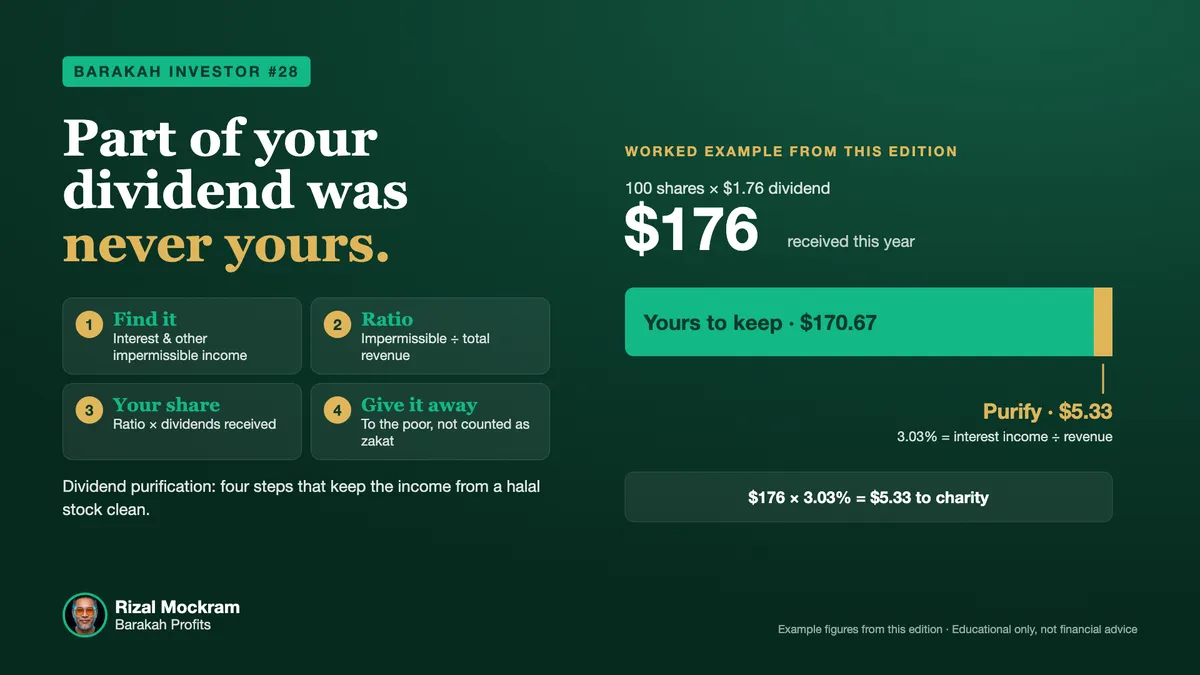
Dividend Purification - A Shareholder's Burden
Welcome back to The Barakah Investor - a weekly newsletter on patient, halal investing taught the right way.
Last week, we discussed competitive moats. Identifying durable advantages helps protect capital. It ensures the business you own can generate consistent cash flows. Today, we address what happens to that cash once it reaches you: dividends, and the necessary purification.
The Shareholder's Burden: Not All Income Is Yours
Dividends are a distribution of a company's profits to its shareholders. For many investors, they represent tangible returns. They can be reinvested or used for consumption. For the halal investor, however, dividends are not always straightforward. A portion often requires purification. This is not optional; it is a religious obligation. To ignore it is to compromise the barakah of your wealth.
Why this matters more for halal investors
Conventional investing largely focuses on total return. A dollar is a dollar. The source of profit is secondary, as long as it's legal. Halal investing adds a layer of scrutiny. Even if a company's primary business is permissible, it may still engage in minor impermissible activities. These activities generate impermissible income. As a shareholder, you are a part-owner of these activities. Therefore, a portion of the dividends you receive from such a company is considered impermissible. It cannot be kept for personal use or reinvested. This is the purification principle. It ensures your wealth remains untainted and pleasing to Allah.
Practical framework for dividend purification
The process involves identifying the impermissible income, calculating your share, and then donating that share to charity. It's not complex, but it requires discipline.
Identify impermissible income sources
Even a shariah-compliant company may have minor impermissible income. This typically comes from interest-bearing accounts, conventional financing arrangements, or impermissible side activities. Examples include interest earned on cash holdings (a common occurrence for any large corporation), or revenue from a conventional loan book if the company also has a financing arm. You need to look for these items in the company's financial statements, specifically the income statement and notes to the financial statements. The most common source for purification is interest income.
Determine the purification ratio
Once you identify the impermissible income, calculate its proportion relative to the company's total revenue. The formula is:
(Impermissible Income / Total Revenue) * 100%. This gives you the purification ratio. Some shariah screening providers, like IdealRatings or MSCI Islamic, often provide these ratios directly. This saves you the work of digging through SEC filings. However, understanding the source of these numbers is critical for a serious practitioner.Calculate your purification amount
Multiply the purification ratio by the total dividends you received from that company. For example, if the ratio is 2% and you received $1,000 in dividends, your purification amount is $20. This $20 is not yours to keep. It must be given away to charity, specifically to the poor or needy, without expecting any worldly benefit. It cannot be counted as zakat.
Document and donate
Keep a clear record of your purification calculations and donations. This ensures transparency and accountability. Donate the purification amount promptly. Delaying it serves no purpose. This is a matter of religious obligation, not financial planning.
Worked example: Purifying TSM dividends
Let's take Taiwan Semiconductor Manufacturing Company (TSM). It is a major component of many halal portfolios. For the fiscal year ending December 31, 2023, TSM reported total revenue of approximately $69.3 billion. They also reported interest income of around $2.1 billion. This interest income is the primary source of impermissible earnings for TSM.
The purification ratio for TSM would be: ($2.1 billion / $69.3 billion) * 100% = 3.03%.
Suppose you own 100 shares of TSM. TSM's annual dividend per share for 2023 was approximately $1.76. Your total dividends received would be 100 shares * $1.76/share = $176.
Your purification amount is: $176 * 3.03% = $5.33.
This $5.33 must be given to charity. You do not keep it. You do not reinvest it. It is not part of your capital. This process applies to any dividend-paying stock in your portfolio that has a non-zero purification ratio. Whether it's Apple (AAPL), Microsoft (MSFT), or any other large-cap, they all generate some interest income. Therefore, purification is almost always necessary.
This week's action
- Review your portfolio for any dividend-paying stocks.
- For each, identify its purification ratio. You can find this through shariah screening services or by manually reviewing their financial statements for interest income relative to total revenue.
- Calculate the total dividends received for each stock over the last year.
- Calculate the purification amount for each, sum them up, and donate the total to a suitable charity.
Next week, we will discuss capital gains and losses. Specifically, how to account for them in a halal portfolio, including the implications for zakat. This follows naturally from our discussion on income and purification.
Rizal M
Founder, Barakah Profits
The Barakah Investor is educational only and not financial advice. Always do your own research and consult a qualified professional where needed.
PS - halal verdicts change, and almost nobody shows you when. We keep a dated, public record of every stock that has crossed our halal screen: the verdict ledger.