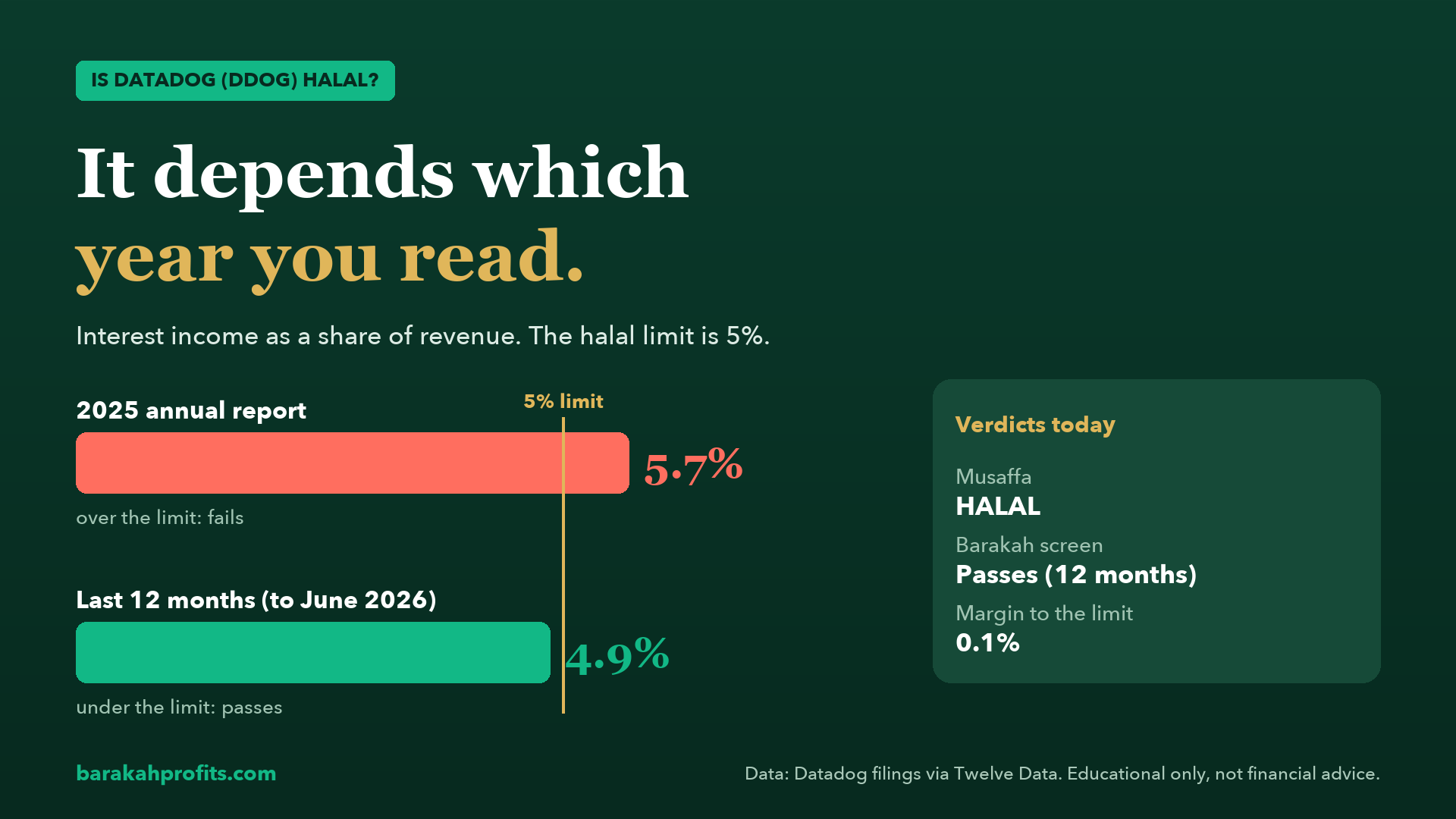
Is Datadog (DDOG) Stock Halal? It Depends Which Year You Read
If you ran DDOG through a halal screen a while back and walked away with a different verdict than you'd get today, you're not imagining things. The screen moved. And if you already own shares, this is a good moment to pull up your notes, because the number that decides this one is sitting right on the line.
What changed
Datadog's non-permissible income check - interest income measured against revenue - is now at 4.9%, against a 5% limit. That's close enough that a small shift in either direction flips the verdict. We don't know the exact cause. It could be that interest income grew as cash balances earned more in a higher-rate environment, it could be a revenue mix shift, or some combination. We're not going to pretend to know more than the filing tells us.
Why this matters more than it looks
Here's the part almost no screening app explains. AAOIFI-style halal screens don't just look at a company's business. For the debt and cash tests, they measure interest-bearing debt and cash against market capitalization - the price the market is paying for the whole company right now. That means a stock can start passing the moment it gets more expensive, and start failing simply because its price fell, with nothing changing inside the business at all. The income test here runs off revenue rather than market cap, but the lesson is the same: these are ratios, and ratios move when either side of the fraction moves. A screen result is a snapshot of a moving target, not a permanent label.
What our screen says today
- Business activity: 100% of revenue comes from its AI-powered observability and security platform for cloud applications - a permissible business.
- Interest-bearing debt: 2.0% of market cap, well under the 30% limit.
- Cash and interest-bearing securities: 7.7% of market cap, well under the 30% limit.
- Non-permissible income: 4.9% of revenue, just under the 5% limit.
Right now, DDOG passes our financial screen. But that last number leaves almost no room. A verdict this close to the cutoff is worth rechecking often, because it doesn't take much to tip it either way.
Is it actually cheap
Passing the halal screen is a different question from whether the price makes sense. DDOG's quality scores are strong in places: Financial Strength at 95, Growth at 100, Predictability at 80. Profitability is more middling at 52, with a 6% profit margin and 6% return on equity. Valuation is where it gets uncomfortable: a score of 0, with the stock trading above our fair-value range of roughly $123.74 to $171.16. At $178.40, it sits about 17% above the midpoint of around $147.45. That's not a business that's cheap right now. It's a good business trading at a price that leaves little margin of safety. Our general approach is to wait for the price to come back toward fair value before considering an entry - and that's not a recommendation to buy even if it does, just a reminder of what discipline looks like.
The takeaway
Halal verdicts have dates on them. If you rejected DDOG before, don't assume that answer still holds. If you own it, don't assume today's pass means you can stop checking. Screens like this move with the market, not just with the business, and a single screenshot from an app never tells you which force moved the needle.
One more thing worth sitting with: if a stock was failing the income test during a period when you held it or earned on it, what to do with that income isn't something an app can answer. That's a question for a scholar, not a screener.
I ran Datadog Inc. Class A through the Barakah Stock Check app - the halal screen, quality scores and fair-value band above come straight from it. Run any ticker in seconds: barakahprofits.com/stock-check (3 days free). And in the Barakah Watch group we flag halal, wide-moat businesses trading below fair value every day.
This is not the only name whose verdict has moved. We keep a public, dated record of every stock that has crossed our halal screen: the halal verdict ledger.
Educational only, not financial advice. The halal screen is an automated estimate - confirm with a scholar-reviewed screener before investing. Figures are point-in-time and change.