What 2008 took from me — and what it gave back
Assalamu alaikum,
I want to tell you a story I don’t usually tell in full.
Not because it’s too painful — I’ve made peace with it. But because every time I start, it’s easy to skip the parts that actually matter and jump to the lesson. So let me try not to do that.
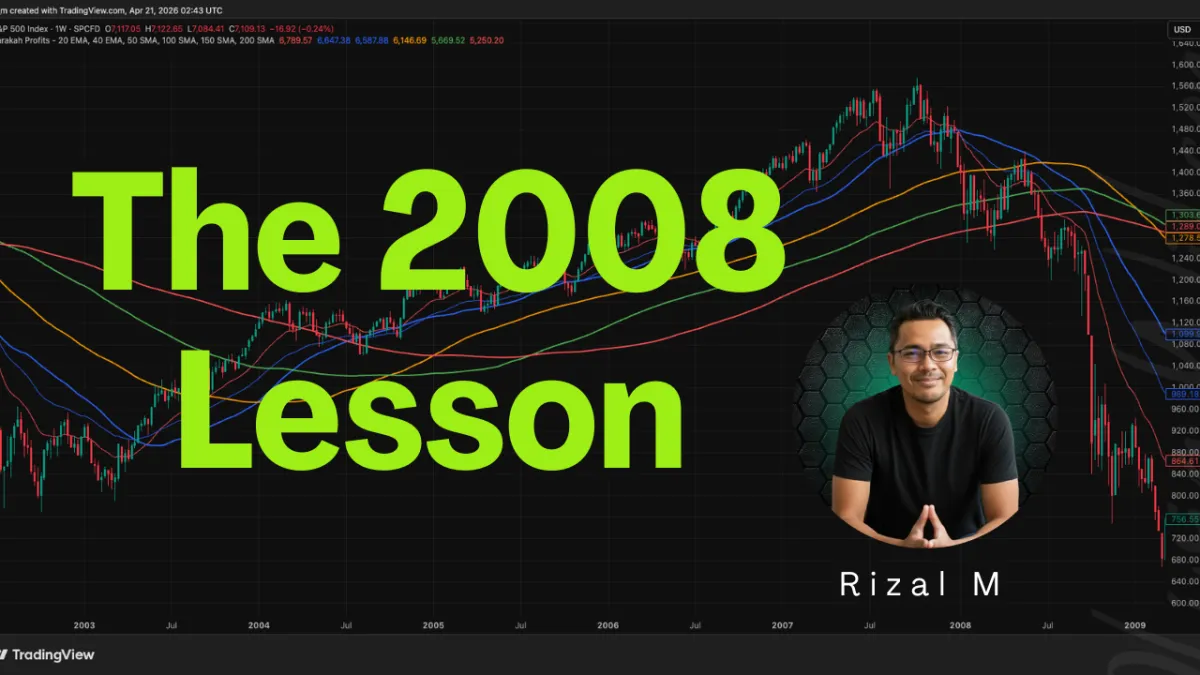
In 2008, I was a proprietary trader.
I had spent years building to that point. Options trading while I was still an auditor at KPMG. Wealth management at Standard Chartered. Then the transition to prop trading — managing real capital, navigating real markets, carrying the weight of real positions.
I was good at it. Not in a boastful way — I’m saying it because it’s relevant to what comes next. I had the training. I had the experience. I had more market knowledge than most retail investors would accumulate in a lifetime.
And then 2008 happened.
The crash didn’t destroy me financially. I want to be honest about that — some people lost everything, and my story is not that story. But it exposed something I had been ignoring.
I had been investing the way everyone else was.
Chasing returns. Using leverage when the opportunity seemed obvious. Treating markets like a performance game where the score was updated every day and better numbers meant you were winning.
I was technically competent. But I had no anchor.
When the market collapsed, when the certainty I’d been building my strategies on evaporated in a matter of weeks, I had no framework for what mattered. Every decision felt like guesswork dressed up as analysis. The tools I’d trusted stopped working. The models that had been reliable became liabilities.
That kind of experience changes you. Not because it breaks something — because it reveals what was already broken.
What I realised — slowly, uncomfortably, over months of reflection — was that I had been confusing sophistication with wisdom.
I was sophisticated. I understood derivatives. I could read a balance sheet faster than most. I knew how to structure positions across multiple instruments to express a view on market direction.
But wisdom is different from sophistication. Wisdom asks: why am I doing this? What am I actually trying to build? What happens if I’m wrong — not just to my portfolio, but to my life?
I hadn’t been asking those questions. Not seriously.
That was when I started thinking about barakah differently.
Not as a religious requirement I was trying to satisfy while also building wealth. Not as a constraint on what I could and couldn’t invest in.
As an actual philosophy of wealth.
The concept of barakah — the blessing and increase that comes from doing things the right way — started to feel less like a nice ideal and more like an investment principle.
Patient capital. Long-term thinking. Owning businesses that create real value for real people. Avoiding structures designed to extract money rather than generate it. Holding for years, not days.
These weren’t just Islamic principles. They were the same principles the greatest long-term investors in history had arrived at, through decades of trial and costly error.
What 2008 did — what it forced me to acknowledge — was that the way I had been investing was actually at odds with the things I said I valued. I believed in honest commerce. I believed in real value creation. I believed in patience and stewardship.
My investment approach didn’t reflect any of that.
The shift that followed wasn’t dramatic. It didn’t happen in a single moment of revelation.
It happened in stages. I stopped using leverage. I started reading businesses rather than just trading them. I began building positions I was genuinely prepared to hold for years — not because the market agreed with me, but because I had done the analysis and I believed in what the company was building.
And I started integrating the halal principles I had always known were important but had sometimes treated as constraints rather than as guides.
The result — and I say this not to brag but because it’s relevant to why I’m writing this newsletter — is that in the years since 2008, I have consistently outperformed the S&P 500 with a 100% halal portfolio.
Not because I got lucky. Not because I found some secret.
Because I finally aligned my investment practice with my actual values.
I think about this a lot when I consider why I built Barakah Profits.
There is an enormous amount of content for Muslim investors about what is halal — which sectors, which ratios, which screens. That information is necessary.
But very little of it addresses how to invest well once you’ve established what you’re allowed to invest in. The methodology. The judgment. The discipline.
That gap is what I want to close with everything I write and teach.
Not because I think I have all the answers. But because the 2008 version of me needed this. He needed someone to say: the halal principles you already hold are not separate from good investing — they are good investing. The patience, the focus on real value, the aversion to speculation — these aren’t things you set aside when you open a brokerage account.
They’re the foundation.
One thing I want to ask you, as we get to know each other through this newsletter:
What’s the gap in your own investing journey right now? What’s the question you haven’t found a clear answer to yet?
Hit reply and tell me. I read every response. And more often than not, the question you’re asking is the one other readers are too afraid to send.
Wassalaam,
Rizal Founder, Barakah Profits Former proprietary trader | Ex-KPMG | Ex-Standard Chartered
P.S. Editions #1 and #2 covered the margin of safety and how to read an annual report as a Muslim investor. If you missed them, they’re on the website. And if you haven’t downloaded the free Halal Stock Scorecard yet — the 5-gate, 21-check framework I use on every stock I evaluate — it’s at barakahprofits.com/scorecard.